
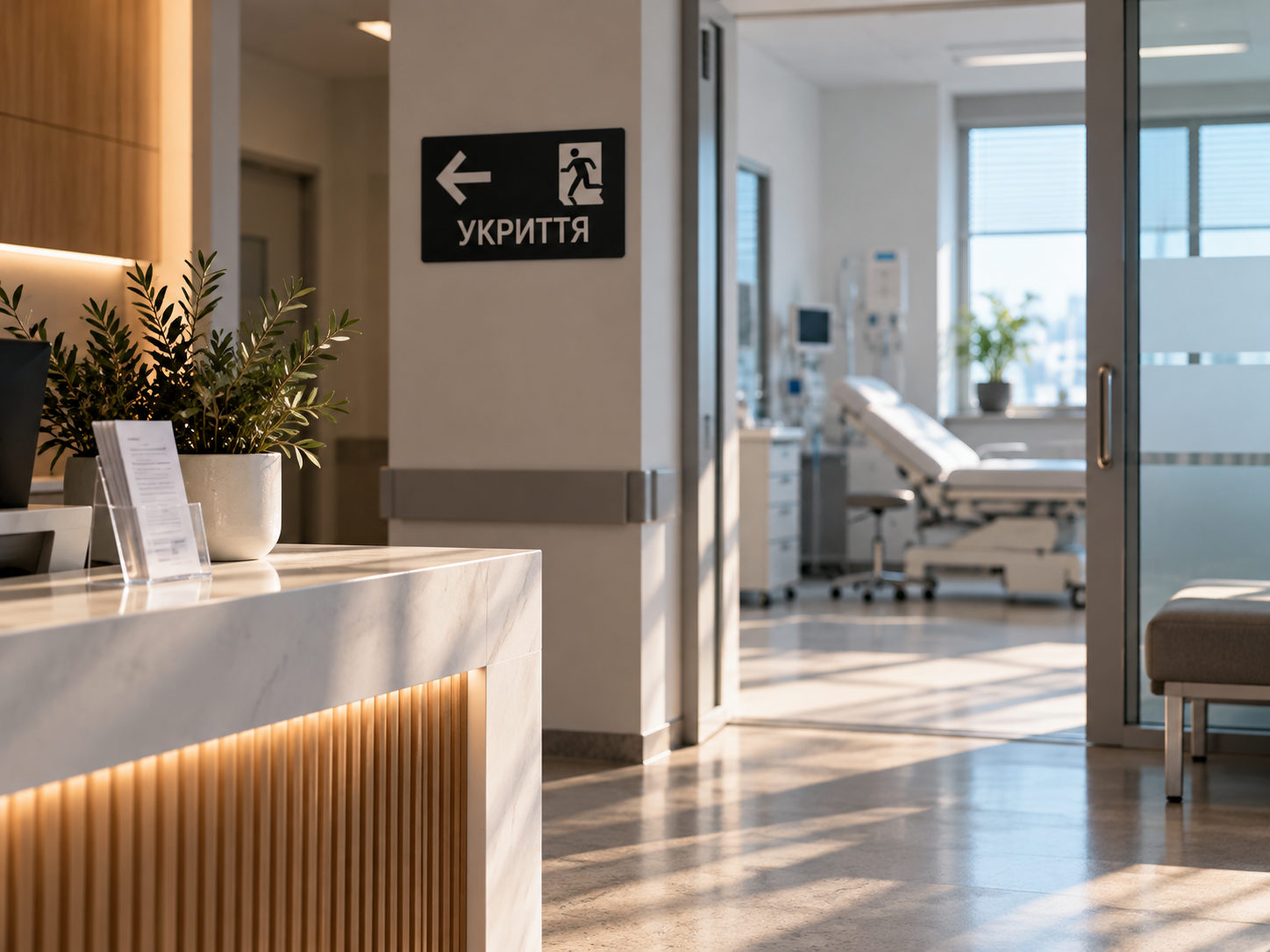
Organizing the operation of healthcare facilities during air raid alerts requires not only ensuring the safety of patients and medical personnel but also complying with applicable legal requirements.
Since September 22, 2026, new rules have governed the operation of healthcare facilities and individual medical practitioners during threats of aerial attacks.
Resolution No. 1158 of the Cabinet of Ministers of Ukraine, dated September 21, 2026, establishes procedures for healthcare businesses depending on the level of threat. In particular, it regulates the provision of medical care during air raid alerts, the use of shelters, and the organization of internal processes within healthcare facilities.
These requirements apply to large healthcare institutions as well as private medical clinics, dental practices, and doctors operating as individual entrepreneurs.
This article examines the main requirements of Resolution No. 1158, the rules governing medical practice during air raid alerts, and the documents healthcare providers must prepare.
Resolution No. 1158: Key Provisions
Resolution No. 1158 of the Cabinet of Ministers of Ukraine, dated September 21, 2026, approved the Procedure for the Operation of Healthcare Business Entities under the Threat of Aerial Attack (hereinafter referred to as the Procedure).
The Procedure applies throughout martial law and for 30 days following its termination.
At the same time, Cabinet of Ministers Resolution No. 1092, dated September 4, 2026, establishes different levels of air raid alerts depending on the nature of the threat:
- Yellow threat level: a threat involving unmanned aerial vehicles (UAVs).
- Red threat level: a threat involving missile attacks, combined missile and drone attacks, or large-scale UAV attacks.
The applicable threat level determines how medical services may be provided, whether new medical procedures can begin, and when patients and personnel must move to shelters.
The Procedure also requires healthcare businesses to approve relevant internal documents and establish clear instructions for personnel during air raid alerts.
Which Healthcare Facilities Must Comply with Resolution No. 1158?
The Procedure applies to healthcare facilities regardless of ownership, individual entrepreneurs licensed to provide medical services, and entities operating within the blood service system.
Accordingly, the requirements apply to multidisciplinary hospitals, private medical centers, dental practices, cosmetology facilities providing licensed medical services, and individual medical practitioners.
Particular attention should be paid to situations where several independent businesses operate from the same premises.
For example, where a legal entity and several doctors registered as individual entrepreneurs provide medical services at the same location, each must comply with the applicable requirements within the scope of its own activities.
This includes approving internal documentation, designating responsible personnel, and ensuring employees are familiar with the relevant procedures.
At the same time, arrangements for using shared shelters, evacuation routes, and notification systems must be coordinated among all businesses operating on the premises.
Yellow Threat Level: How Can a Medical Clinic Operate?
During a yellow threat level, the Procedure allows healthcare facilities to continue operating in their regular premises, provided that the required safety measures are observed.
In particular:
- Medical facilities may continue scheduled patient appointments.
- Access to a shelter or designated protected area must be ensured.
- Patients must be informed about the location of the nearest shelter.
- Patients may independently decide whether to remain at the clinic or proceed to a shelter.
Where a healthcare facility does not have its own shelter, an area offering the lowest risk of injury must be identified.
Such an area may include an interior room separated from external walls and windows by at least two load-bearing walls.
Certain transitional provisions establish specific arrangements for healthcare facilities without their own shelters.
In particular, the original regulatory framework provides for the possibility of continuing operations with the agreement of the workforce during a transitional period ending on December 4, 2026.
Healthcare facilities without their own shelters should therefore determine in advance how the safety of patients and personnel will be ensured after the transitional period expires.
Red Threat Level: Which Medical Services May Continue?
During a red threat level, stricter restrictions apply to the organization of medical practice.
As a general rule, new scheduled appointments, medical interventions, and procedures must not begin.
Exceptions apply where postponing medical care could endanger a patient’s life or health.
The attending physician makes the relevant decision based on the patient’s condition and the nature of the medical intervention.
What If Treatment Has Already Started?
If a medical procedure began before the red threat level was announced, the physician must assess whether it can be safely interrupted.
Where immediate interruption could endanger the patient, the procedure must be brought to a safe stage or completed.
This may apply, in particular, to:
- Surgical interventions;
- Procedures involving anesthesia;
- Emergency medical care;
- Other medical procedures where interruption could endanger the patient.
In dental practice, such measures may include controlling bleeding, placing sutures, applying a temporary filling, or placing a protective dressing.
After completing the necessary medical measures, the patient and healthcare personnel must follow the approved safety procedures.
Moving Patients and Personnel to Shelters
During a red threat level, employees, patients, and visitors must move to the designated shelter.
Healthcare facilities must establish procedures for assisting individuals who cannot move independently.
Particular attention should be given to children, patients with reduced mobility, and individuals undergoing medical treatment.
Elevators must not be used during evacuation.
However, patients requiring emergency medical care must receive such assistance regardless of the applicable threat level.
Where the shelter is located outside the clinic and only one medical professional is providing services, appointments must be suspended for the duration of the red threat level.
Patients must also be informed about the nearest shelter and how to contact emergency medical services.
Can Medical Care Be Provided in a Shelter?
Paragraph 4 of the Procedure establishes specific rules concerning the provision of medical care in shelters and protected premises.
In particular, providing medical care in such circumstances is not treated as a violation of medical licensing requirements or as conducting medical practice at an undeclared location.
This provision is particularly important for private clinics and individual medical practitioners, as it allows necessary medical care to be provided while taking security circumstances into account.
What Documents Must Healthcare Facilities Approve Under Resolution No. 1158?
One of the principal requirements of the Procedure is the proper documentation of how healthcare facilities operate during air raid alerts.
Under paragraph 31 of the Procedure, the head of a healthcare facility or, in the case of an individual medical practitioner, the entrepreneur personally, must ensure that certain organizational measures are implemented.
These include the following.
1. Approving Staff Response Procedures
Internal procedures must establish how personnel should act during yellow and red threat levels.
They should address the provision of medical care, patient evacuation, and situations where ongoing treatment cannot be immediately interrupted.
Employees must be familiarized with the relevant documents.
2. Identifying Protected Areas and the Nearest Shelter
Healthcare facilities must identify areas offering the lowest risk of injury, establish evacuation routes, and determine how patients will be informed about available shelters.
3. Identifying Medical Procedures That Cannot Be Immediately Interrupted
The relevant list must reflect the medical facility’s specific services and specialties.
For example, procedures that cannot be immediately interrupted in a dental practice will differ significantly from those performed in a multidisciplinary hospital or inpatient facility.
4. Designating Responsible Personnel
Specific employees must be appointed to organize patient movement, including assisting individuals who cannot reach shelters independently.
5. Establishing Procedures When Reaching a Shelter Is Impossible
Internal instructions must provide for safety measures where immediate evacuation is impossible.
These may include moving people away from windows and directing them to designated protected areas.
6. Assessing the Location of Workstations
Healthcare facilities must consider the distance between workstations and windows and implement measures to reduce potential injury risks.
In addition, Resolution No. 1092 establishes requirements for informing personnel and visitors about air raid alerts and displaying relevant information signs.
In particular, the regulations provide for signs measuring 100 × 60 cm indicating whether the premises have a shelter or designated safe area.
What Happens If the Required Documents Were Not Approved on Time?
The Procedure establishes a deadline for implementing the relevant organizational measures.
Under the original provisions of Resolution No. 1158, this deadline is linked to the entry into force of Cabinet of Ministers Resolution No. 1092.
Materials concerning the implementation of the Procedure identify October 4, 2026, as the relevant deadline.
If a healthcare facility or individual medical practitioner has not yet approved the required documents, the necessary measures should be taken as soon as possible.
Legal Significance of Approved Response Procedures
Having approved internal response procedures is important when assessing the legality of decisions made by healthcare personnel during air raid alerts.
The Procedure provides for consideration of the circumstances and information available at the time the relevant decision was made.
Properly developed and approved procedures help demonstrate that the healthcare facility established clear staff instructions and organized appropriate safety measures in advance.
However, the existence of written procedures does not eliminate the obligation to implement them in practice.
Are There Penalties for Missing Documentation?
Resolution No. 1158 does not establish a separate, specific fine solely for failing to approve internal response procedures.
Nevertheless, this does not mean that non-compliance cannot have legal consequences.
The organization of safe working conditions and the protection of patients and employees are also governed by legislation concerning civil protection, occupational safety, and the general obligations of business entities.
In the event of a dispute or harm, the circumstances surrounding the organization of the healthcare facility’s operations may be relevant when determining liability.
Documents must be approved using their actual dates of adoption.
Backdating orders or other internal documents may create additional legal risks.
Additional Legal Considerations for Healthcare Facilities
In addition to approving the required organizational documents, healthcare providers should review other aspects of their operations.
Medical Services Agreements
Agreements with patients and public offers should expressly address the provision of medical services during air raid alerts.
In particular, they should establish procedures for rescheduling appointments or temporarily suspending planned services where required by law.
It is not advisable to automatically classify every air raid alert as a force majeure event.
Instead, healthcare facilities should establish a separate contractual mechanism reflecting their operational requirements and patients’ rights.
Patient Rules and Information
Patients should understand what happens when an air raid alert is announced.
Therefore, internal patient rules should address:
- Whether appointments may continue or must be suspended;
- Procedures for moving to shelters;
- Actions to be taken when medical treatment is interrupted;
- Rescheduling appointments;
- Specific arrangements for emergency medical care.
Properly informing patients helps reduce misunderstandings and potential complaints.
Requirements for Different Medical Specialties
Internal documentation must reflect the actual nature of the medical services provided.
For example, dental practices must establish procedures for safely completing interventions that cannot be immediately interrupted.
Medical cosmetology facilities must consider the specific characteristics of their procedures and equipment.
Consequently, using generic templates without adapting them to the facility’s particular medical specialties may be insufficient.
Several License Holders Operating from the Same Premises
Where several independent business entities operate from the same premises, their internal documentation should be coordinated.
This is particularly important for notification procedures, shelter access, evacuation routes, and the allocation of organizational responsibilities.
A separate cooperation agreement may be an appropriate way to regulate these matters.
Workstations Located Near Windows
Certain workstations in healthcare facilities, including dental chairs and treatment equipment, may be permanently installed near windows.
In such cases, the relevant risks should be assessed and appropriate mitigation measures identified.
The assessment and adopted organizational measures should be documented.
Compliance Checklist: Is Your Clinic Prepared for Air Raid Alerts?
Healthcare providers can use the following checklist to conduct an initial assessment of their compliance with Resolution No. 1158.
☐ Have staff response procedures for yellow and red threat levels been formally approved?
☐ Have employees been familiarized with these procedures, and is there a process for informing new employees?
☐ Have the safest available areas and the nearest shelter been identified?
☐ Has the facility approved a list of medical procedures that cannot be immediately interrupted, taking into account its specialties?
☐ Have responsible personnel been designated for notifications, assistance to patients with reduced mobility, and evacuation arrangements?
☐ Have risks associated with workstations located near windows been assessed, and have appropriate safety measures been identified?
☐ Have arrangements for operating without an on-site shelter been reviewed in light of the applicable transitional provisions?
☐ Has the required information sign been displayed at the entrance in accordance with Resolution No. 1092?
☐ Are patients informed about air raid procedures and the location of the nearest shelter?
☐ Do medical services agreements address the postponement or suspension of scheduled appointments during air raid alerts?
☐ Have patient rules been updated to include air raid response procedures?
☐ Where several businesses operate from the same premises, have their internal procedures been coordinated?
If any of these matters remain unresolved, the healthcare facility should conduct an additional review and update the relevant documentation.
This checklist is intended for general guidance and does not replace a comprehensive legal compliance assessment.
Legal Support for Healthcare Facilities Under Resolution No. 1158
Law Firm “Kavchuk & Partners” provides legal assistance to private healthcare facilities, dental clinics, and individual medical practitioners concerning compliance with Ukrainian healthcare legislation.
In particular, our services relating to Cabinet of Ministers Resolution No. 1158 include:
Legal audit of existing documentation. We review a healthcare facility’s internal documents and identify which documents need to be prepared or updated.
Preparation of internal procedures. We develop staff response procedures for air raid alerts, internal orders, lists of medical processes, documents designating responsible personnel, and patient information materials.
Updating contractual documentation. We introduce the necessary amendments to medical services agreements, public offers, and patient rules.
Legal structuring of cooperation between multiple license holders. We coordinate the internal documents of business entities operating from shared premises and prepare the relevant cooperation agreements.
When preparing documentation, we take into account the healthcare facility’s medical specialties, staff organization, premises, and the nature of the medical services provided.
Contact Law Firm “Kavchuk & Partners” for legal advice and assistance in ensuring your healthcare facility’s compliance with Resolution No. 1158.


